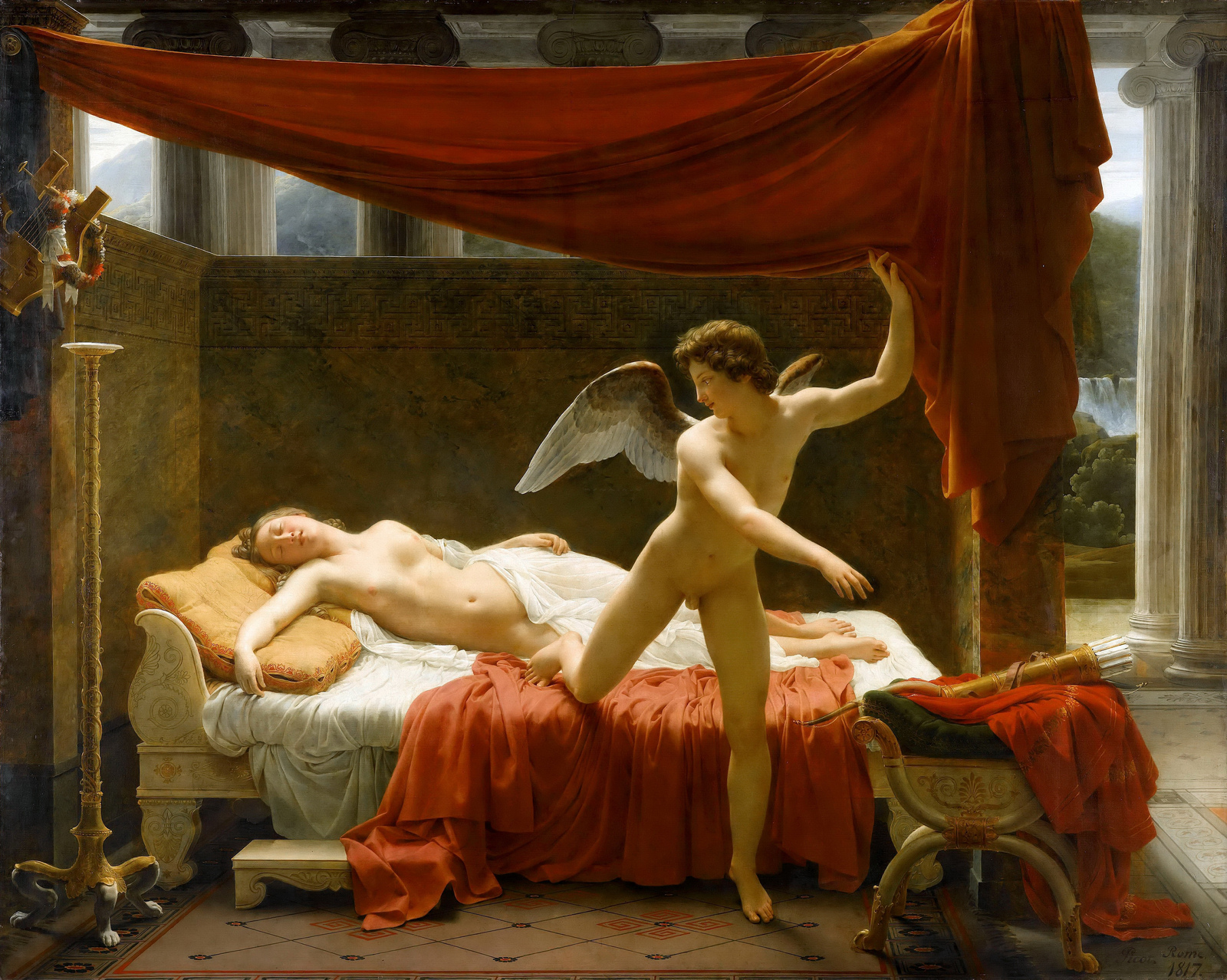
Let Psyches corps be clad in mourning weed, And set on rock of yonder hill aloft : Her husband is no wight of humane seed, But Serpent dire and fierce as might be thought. Who flies with wings above in starry skies, And doth subdue each thing with firie flight. The gods themselves, and powers that seem so wise, With mighty Jove, be subject to his might, The rivers blacke, and deadly flouds of paine And darkness eke, as thrall to him remaine.
The King, sometimes happy when he heard the prophesie of Apollo, returned home sad and sorrowful, and declared to his wife the miserable and unhappy fate of his daughter. Then they began to lament and weep, and passed over many dayes in great sorrow. But now the time approached of Psyches marriage, preparation was made, blacke torches were lighted, the pleasant songs were turned into pittifull cries, the melody of Hymeneus was ended with deadly howling, the maid that should be married did wipe her eyes with her vaile. All the family and people of the city weeped likewise, and with great lamentation was ordained a remisse time for that day, but necessity compelled that Psyches should be brought to her appointed place, according to the divine appointment.
And when the solemnity was ended, they went to bring the sorrowful spowse, not to her marriage, but to her final end and burial. And while the father and mother of Psyches did go forward weeping and crying unto this enterprise, Psyches spake unto them in this sort : Why torment your unhappy age with continuall dolour? Why trouble you your spirits, which are more rather mine than yours? Why soyle ye your faces with teares, which I ought to adore and worship? Why teare you my eyes in yours? why pull you your hory haires? Why knocke ye your breasts for me? Now you see the reward of my excellent beauty : now, now you perceive, but too late, the plague of envy. When the people did honour me, and call me new Venus, then yee should have wept, then you should have sorrowed as though I had been dead : for now I see and perceive that I am come to this misery by the only name of Venus, bring mee, and as fortune has appointed, place me on the top of the rocke, I greatly desire to end my marriage, I greatly covet to see my husband. Why doe I delay? why should I refuse him that is appointed to destroy all the world.
Thus ended she her words, and thrust her selfe among the people that followed. Then they brought her to the appointed rocke of the high hill, and set [her] hereon, and so departed. The Torches and lights were put out with the teares of the people, and every man gone home, the miserable Parents well nigh consumed with sorrow, gave themselves to everlasting darknes.
Thus poore Psyches being left alone, weeping and trembling on the toppe of the rocke, was blowne by the gentle aire and of shrilling Zephyrus, and carried from the hill with a meek winde, which retained her garments up,, and by little and little bought her downe into a deepe valley, where she was laid in a bed of most sweet and fragrant flowers.
Thus faire Psyches being sweetly couched among the soft and tender hearbs, as in a bed of sweet and fragrant floures, and having qualified the thoughts and troubles of her restlesse minde, was now well reposed. And when she had refreshed her selfe sufficiently with sleepe, she rose with a more quiet and pacified minde, and fortuned to espy a pleasant wood invironed with great and mighty trees. Shee espied likewise a running river as cleare as crystall : in the midst of the wood well nigh at the fall of the river was a princely Edifice, wrought and builded not by the art or hand of man, but by the mighty power of God : and you would judge at the first entry therin, that it were some pleasant and worthy mansion for the powers of heaven. For the embowings above were of Citron and Ivory, propped and undermined with pillars of gold, the walls covered and seeled with silver, divers sorts of beasts were graven and carved, that seemed to encounter with such as entered in. All things were so curiously and finely wrought, that it seemed either to be the worke of some Demy god, or of God himselfe. The pavement was all of pretious stones, divided and cut one from another, whereon was carved divers kindes of pictures, in such sort that blessed and thrice blessed were they that might goe upon such a pavement: Every part and angle of the house was so well adorned, that by reason of the pretious stones and inestimable treasure there, it glittered and shone in such sort, that the chambers, porches, and doores gave light as it had beene the Sunne. Neither otherwise did the other treasure of the house disagree unto so great a majesty, that verily it seemed in every point an heavenly Palace, fabricate and built for Jupiter himselfe.
Then Psyches moved with delectation approched nigh and taking a bold heart entred into the house, and beheld every thing there with great affection, she saw storehouses wrought exceedingly fine, and replenished with aboundance of riches. Finally, there could nothing be devised which lacked there: but among such great store of treasure this was most marvellous, that there was no closure, bolt, nor locke to keepe the same. And when with great pleasure shee had viewed all these things, she heard a voyce without any body, that sayd, Why doe you marvell Madame at so great riches? behold, all that you see is at your commandement, wherefore goe you into the chamber, and repose your selfe upon the bed, and desire what bath you will have, and wee whose voyces you heare bee your servants, and ready to minister unto you according to your desire. In the meane season, royall meats and dainty dishes shall be prepared for you.
Then Psyches perceived the felicity of divine providence, and according to the advertisement of the incorporeall voyces she first reposed her selfe upon the bed, and then refreshed her body in the baines. This done, shee saw the table garnished with meats, and a chaire to sit downe.
When Psyches was set downe, all sorts of divine meats and wines were brought in, not by any body, but as it were with a winde, for she saw no person before her, but only heard voyces on every side. After that all the services were brought to the table, one came in and sung invisibly, another played on the harpe, but she saw no man. The harmony of the Instruments did so greatly shrill in her eares, that though there were no manner of person, yet seemed she in the midst of a multitude of people.
All these pleasures finished, when night aproched Psyches went to bed, and when she was layd, that the sweet sleep came upon her, she greatly feared her virginity, because shee was alone. Then came her unknowne husband and lay with her : and after that hee had made a perfect consummation of the marriage, he rose in the morning before day, and departed. Soone after came her invisible servants, and presented to her such things as were necessary for her defloration. And thus she passed forth a great while, and as it happeneth, the novelty of the things by continuall custome did encrease her pleasure, but especially the sound of the instruments was a comfort to her being alone.
During this time that Psyches was in this place of pleasures, her father and mother did nothing but weepe and lament, and her two sisters hearing of her most miserable fortune, came with great dolour and sorrow to comfort and speake with her parents.
The night following , Psyches husband spake unto her (for she might feele his eyes, his hands, and his ears) and sayd, O my sweet Spowse and dear wife, fortune doth menace unto thee imminent danger, wherof I wish thee greatly to beware : for know that thy sisters, thinking that thou art dead, bee greatly troubled, and are coming to the mountain by thy steps. Whose lamentations if thou fortune to heare, beware that thou doe in no wise make answer, or looke up towards them, for if thou doe thou shalt purchase to mee great sorrow, and to thyself utter destruction. Psyches hearing her Husband, was contented to doe all things as hee had commanded.
After that hee was departed and the night passed away, Psyches lamented and lamented all the day following, thinking that now shee was past all hopes of comfort, in that shee was closed within the walls of a prison, deprived of humane conversation, and commaunded not to aid her sorrowful Sisters, no nor once to see them. Thus she passed all the day in weeping, and went to bed at night, without any refection of meat or baine.
Incontinently after came her husband, who when he had embraced her sweetly, began to say, Is it thus that I find you perform your promise, my sweet wife? What do I finde heere? Passe you all the day and the night in weeping? And wil you not cease in your husbands armes? Goe too, doe what ye will, purchase your owne destruction, and when you find it so, then remember my words, and repent but too late. Then she desired her husband more and more, assuring him that shee should die, unlesse he would grant that she might see her sisters, wherby she might speak with them and comfort them, wherat at length he was contented, and moreover hee willed that shee should give them as much gold and jewels as she would. But he gave her a further charge saying, Beware that ye covet not (being mooved by the pernicious counsell of you sisters) to see the shape of my person, lest by your curiosity you deprive your selfe of so great and worthy estate. Psyches being glad herewith, rendered unto him most entire thankes, and said, Sweet husband, I had rather die than to bee separated from you, for whosoever you bee, I love and retaine you within my heart, as if you were myne owne spirit or Cupid himselfe: but I pray you grant this likewise, that you would commaund your servant Zephyrus to bring my sisters downe into the valley as he brought mee.
Wherewithall shee kissed him sweetly, and desired him gently to grant her request, calling him her spowse, her sweetheart, her Joy and her Solace. Wherby she enforced him to agree to her mind, and when morning came he departed away.
After long search made, the sisters of Psyches came unto the hill where she was set on the rocke, and cried with a loud voyce in such sort that the stones answered againe. And when they called their sister by her name, that their lamentable cries came unto her eares, shee came forth and said, Behold, heere is shee for whom you weepe, I pray you torment your selves no more, cease your weeping. And by and by she commaunded Zephyrus by the appointment of her husband to bring them downe. Neither did he delay, for with gentle blasts he retained them up and laid them softly in the valley. I am not able to expresse the often embracing, kissing and greeting which was between them three, all sorrows and tears were then layd apart.
Come in (quoth Psyches) into our house, and refresh your afflicted mindes with your sister.
After this she shewed them the storehouses of treasure, shee caused them to hear the voyces which served her, the bain was ready, the meats were brought in, and when they had filled themselves with divine delecates, they conceived great envy within their hearts, and one of them being curious, did demand what her husband was, of what estate, and who was Lord of so pretious a house? But Psyches remembring the promise which she had made to her husband, feigned that hee was a young man, of comely stature, with a flaxen beard, and had great delight in hunting the dales and hills by. And lest by her long talke she should be found to trip or faile in her words, she filled their laps with gold, silver, and Jewels, and commanded Zephyrus to carry them away.
When they were brought up to the mountain, they made their wayes homeward to their owne houses, and murmured with envy that they bare against Psyches, saying, behold cruell and contrary fortune, behold how we, borne all of one Parent, have divers destinies : but especially we that are the elder two bee married to strange husbands, made as handmaidens, and as it were banished from our Countrey and friends. Whereas our younger sister hath great abundance of treasure, and hath gotten a god to her husband, although shee hath no skill how to use such great plenty of riches. Saw you not sister what was in the house, what great store of jewels, what glittering robes, what Gemmes, what gold we trod on? That if shee hath a husband according as shee affirmeth, there is none that liveth this day more happy in all the world than she. And so it may come to passe, at length for the great affection which hee may beare unto her that hee may make her a goddesse, for by Hercules, such was her countenance, so she behaved her self, that as a goddesse she had voices to serve her, and the windes did obey her.
But I poore wretch have first married an husband elder than my father, more bald than a Coot, more weake than a childe, and that locketh me up all day in the house.
Then said the other sister, And in faith I am married to a husband that hath the gout, twyfold, crooked, nor couragious in paying my debt, I am faine to rub and mollifie his stony fingers with divers sorts of oyles, and to wrap them in playsters and salves, so that I soyle my white and dainty hands with the corruption of filthy clouts, not using my self like a wife, but more like a servant. And you my sister seem likewise to be in bondage and servitude, wherefore I cannot abide to see our younger sister in such felicity; saw you not I pray you how proudly and arrogantly she handled us even now? And how in vaunting her selfe she uttered her presumptuous minde, how she cast a little gold into our laps, and being weary of our company, commanded that we should be borne and blown away?
Verily I live not, nor am a woman, but I will deprive her of all her blisse. And if you my sister bee so far bent as I, let us consult together, and not to utter our minde to any person, no not to our parents, nor tell that ever we saw her. For it sufficeth that we have seene her, whom it repenteth to have seene. Neither let us declare her good fortune to our father, nor to any other, since as they seeme not happy whose riches are unknowne : so shall she know that she hath sisters no Abjects, but worthier than she.
But now let us goe home to our husbands and poore houses, and when we are better instructed, let us return to suppresse her pride. So this evill counsell pleased these two evil women, and they hid the treasure which Psyches gave them, and tare their haire, renewing their false and forged teares. When their father and mother beheld them weep and lament still, they doubled their sorrowes and griefes, but full of yre and forced with Envy, they tooke their voyage homeward, devising the slaughter and destruction of their sister.
In the meane season the husband of Psyches did warne her againe in the night with these words : Seest thou not (quoth he) what perill and danger evill fortune doth threaten unto thee, whereof if thou take not good heed it will shortly come upon thee. For the unfaithfull harlots doe greatly endeavor to set their snares to catch thee, and their purpose is to make and perswade thee to behold my face, which if thou once fortune to see, as I have often told, thou shalt see no more. Wherfore if these naughty hagges, armed with wicked minds, doe chance to againe (as I think no otherwise but that they will) take heed that thou talk not with them but simply suffer them to speake what they will, howbeit if thou canst not refraine thy selfe, beware that thou have no communication of thy husband, nor answer a word if they fortune to question of me, so will we encrease our stocke, and this young and tender childe, couched in this young and tender belly of thine, shall be made an immortall god, otherwise a mortal creature. Then Psyches was very glad that she should bring forth a divine babe, and very joyfull in that she should be honored as a mother. She reckened and numbered carefully the days and months that passed, and beeing never with child before, did marvel greatly that in so short a time her belly should swel so big. But those pestilent and wicked furies breathing out their Serpentine poyson, took shipping to bring their enterprise to passe. The Psyches was warned again by her husband in this sort: Behold the last day, the extream case, and the enemies of thy blood, hath armed themselves against us, pitched their campe, set their host in array, and are marching towards us, for now thy two sisters have drawn their swords and are ready to slay thee. O with what force are we assailed on this day! O sweet Psyches I pray thee to take pitty on thy selfe, of me, and deliver thy husband and this infant within thy belly from so great danger, and see not, neither heare these cursed women, which are not worthy to be called thy sisters, for their great hatred and breach of sisterly amity, for they wil come like Syrens to the mountains, and yeeld out their pittious and lamentable cries. When Psyches had heard these words she sighed sorrowfully and said, O deare husband this long time have you had experience and triall of my faith, and doubt you not that I will persever in the same, wherefore command your winde Zephyrus, that hee may doe as hee hath done before, to the intent that where you have charged me not to behold your venerable face, yet that I may comfort myself with the sight of my sisters. I pray you by these beautifull haires, by these round cheekes delicate and tender, by your pleasant hot breast, whose shape and face I shall learn at length by the childe in my belly, grant the fruit of my desire, refresh your deare Spowse Psyches with joy, who is bound and linked unto you for ever. I little esteeme to see your visage and figure, little doe I regard the night and darknesse thereof, for you are my only light.
Her husband being as it were inchanted with these words and compelled by violence of her often embracing, wiping away her teares with his haire, did yeeld unto his wife. And when morning came, departed as hee was accustomed to doe.
Now her sisters arrived on land, and never rested til they came to the rock, without visiting their parents, and leapt down rashly from the hill themselves. Then Zephyrus according to the divine commandment brought them down, although it were against his wil, and laid them in the vally without any harm : by and by they went into the palace to their sister without leave, and when they had eftsoone embraced their prey, and thanked her with flattering words for the treasure which she gave them, they said, O deare sister Psyches, know you that you are now no more a child, but a mother : O what great joy beare you unto us in your belly? What a comfort will it be unto all the house? How happy shall we be, that shall see this Infant nourished amongst so great plenty of Treasure? That if he be like his parents, as it is necessary he should, there is no doubt but a new cupid shall be borne. By this kinde of measures they went about to winne Psyches by little and little, but because they were wearie with travell, they sate them downe in chaires, and after that they had washed their bodies in baines they went into a parlour, where all kinde of meats were ready prepared. Psyches commanded one to play with his harpe, it was done. Then immediately others sung, others tuned their instruments, but no person was seene, by whose sweet harmony and modulation the sisters of Psyches were greatly delighted.
Howbeit the wickednesse of these cursed women was nothing suppressed by the sweet noyse of these instruments, but they settled themselves to work their treasons against Psyches, demanding who was her husband, and of what Parentage. Then shee having forgotten by too much simplicity, what shee had spoken before of her husband, invented a new answer, and said that her husband was of a great province, a merchant, and a man of middle age, having his beard intersparsed with grey haires. Which when shee had spoken (because shee would have no further talke) she filled their laps with Gold and Silver, and bid Zephyrus to bear them away.
In their returne homeward they murmured within themselves, saying, How say you sister to so apparent a lye of Psyches? First she sayd that her husband was a young man of flourishing yeares, and had a flaxen beard, and now she sayth that he is halfe grey with age. What is he that in so short a space can become so old? You shall finde it no otherwise my sister, but that either this cursed queane hath invented a great lie, or else that she never saw the shape of her husband. And if it be so that she never saw him, then verily she is married to some god, and hath a young god in her belly. But if it be a divine babe, and fortune to come to the eares of my mother (as God forbid it should) then may I go and hang my selfe : wherfore let us go to our parents, and with forged lies let us colour the matter.
After they were thus inflamed, and had visited their Parents, they returned againe to the mountaine, and by the aid of the winde Zephyrus were carried down into the valley, and after they had streined their eye lids, to enforce themselves to weepe, they called unto Psyches in this sort, Thou (ignorant of so great evill) thinkest thy selfe sure and happy, and sittest at home nothing regarding thy peril, whereas wee goe about thy affaires and are carefull lest any harme should happen unto you: for we are credibly informed, neither can we but utter it unto you, that there is a great serpent full of deadly poyson, with a ravenous gaping throat, that lieth with thee every night Remember the Oracle of Apollo, who pronounced that thou shouldest he married to a dire and fierce Serpent, and many of the Inhabitants hereby, and such as hunt about in the countrey, affirme that thev saw him yesternight returning from pasture and swimming over the River, whereby they doe undoubtedly say, that hee will not pamper thee long with delicate meats, but when the time of delivery shall approach he will devoure both thee and thy child : wherefore advise thy selfe whether thou wilt agree unto us that are carefull of thy safety, and so avoid the perill of death, bee contented to live with thy sisters, or whether thou remaine with the Serpent arid in the end be swallowed into the gulfe of his body. And if it be so that thy solitary life, thy conversation with voices, this servile and dangerous pleasure, and the love of the Serpent doe more delight thee, say not but that we have played the parts of naturall sisters in warning thee.
Then the poore and simple miser Psyches was mooved with the feare of so dreadful words, and being amazed in her mind, did cleane forget the admonitions of her husband, and her owne promises made unto him, and throwing her selfe headlong into extreame misery, with a wanne and sallow countenance, scantly uttering a third word, at length gan say in this sort : O my most deare sisters, I heartily thanke you for your great kindnesse toward me, and I am now verily perswaded that they which have informed you hereof hath informed you of nothing but truth, for I never saw the shape of my husband, neither know I from whence he came, only I heare his voice in the night, insomuch that I have an uncertaine husband, and one that loveth not the light of the day : which causeth me to suspect that he is a beast, as you affirme. Moreover, I doe greatly feare to see him, for he doth menace and threaten great evill unto mee, if I should goe about to spy and behold his shape wherefore my loving sisters if you have any wholeome remedy for your sister in danger, give it now presently. Then they opened the gates of their subtill mindes, and did put away all privy guile, and egged her forward in her fearefull thoughts, perswading her to doe as they would have her whereupon one of them began and sayd, Because that wee little esteeme any perill or danger, to save your life we intend to shew you the best way and meane as we may possibly do. Take a sharpe razor and put it under the pillow of your bed; and see that you have ready a privy burning lampe with oyle, hid under some part of the hanging of the chamber, and finely dissembling the matter when according to his custome he commeth to bed and sleepeth soundly, arise you secretly, and with your bare feet goe and take the lampe, with the Razor in your right hand and with valiant force cut off the head of the poysonous serpent, wherein we will aid and assist you : and when by the death of him you shall be made safe, we wil marry you to some comely man.
After they had thus inflamed the heart of their sister fearing lest some danger might happen unto them by reason of their evill counsell, they were carried by the wind Zephyrus to the top of the mountaine, and so they ran away and tooke shipping.
When Psyches was left alone (saving that she seemed not to be alone, being stirred by so many furies) she was in a tossing minde like the waves of the sea, and although her wil was obstinate, and resisted to put in execution the counsell of her Sisters, yet she was in doubtfull and divers opinions touching her calamity. Sometime she would, sometime she would not, sometime she is bold, sometime she feareth, sometime shee mistrusteth, somtime she is mooved, somtime she hateth the beast, somtime she loveth her husband : but at length night came, when as she prepared for her wicked intent.
Soon after her husband Came, and when he had kissed and embraced her he fell asleep. Then Psyches (somwhat feeble in body and mind, yet mooved by cruelty of fate) received boldnes and brought forth the lampe, and tooke the razor, so by her audacity she changed her mind : but when she took the lamp and came to the bed side, she saw the most meeke and sweetest beast of all beasts, even faire Cupid couched fairly, at whose sight the very lampe encreased his light for joy, and the razor turned his edge.
But when Psyches saw so glorious a body shee greatly feared, and amazed in mind, with a pale countenance all trembling fel on her knees and thought to hide the razor, yea verily in her owne heart, which doubtlesse she had done, had it not through feare of so great an enterprise fallen out of her hand. And when she saw and beheld the beauty of the divine visage shee was well recreated in her mind, she saw his haires of gold, that yeelded out a sweet savor, his neck more white than milk, his purple cheeks, his haire hanging comely behinde and before, the brightnesse whereof did darken the light of the lamp, his tender plume feathers, dispersed upon his sholders like shining flours, and trembling hither and thither, and his other parts of his body so smooth and so soft, that it did not repent Venus to beare such a childe. At the beds feet lay his bow, quiver, and arrowes, that be the weapons of so great a god : which when Psyches did curiously behold, she marvelling at her husbands weapons, took one of the arrows out of the quiver, and pricked her selfe withall, wherwith she was so grievously wounded that the blood followed, and thereby of her owne accord shee added love upon love; then more broyling in the love of Cupid shee embraced him and kissed him and kissed him a thousand times, fearing the measure of his sleepe But alas while shee was in this great joy, whether it were for envy for desire to touch this amiable body likewise, there fell out a droppe of burning oyle from the lampe upon the right shoulder of the god. O rash and bold lampe, the vile ministery of love, how darest thou bee so bold as to burne the god of all fire? When as he invented thee, to the intent that all lovers might with more joy passe the nights in pleasure.
Part Two:To regain her husband Cupid, Psyches (usually known as Psyche) must undergo dangerous labors imposed upon her by her mother-in-law Aphrodite in order to prove Psyches is worthy of the god Cupid.
The god beeing burned in this sort, and perceiving that promise and faith was broken, bee fled away without utterance of any word, from the eves and hands of his most unhappy wife. But Psyches fortuned to catch him as hee was rising by the right thigh, and held him fast as hee flew above in the aire, until such time as constrained by wearinesse shee let goe arid fell downe upon the ground. But Cupid followed her downe, and lighted upon the top of a Cypresse tree, and angerly spake unto her in this manner : O simple Psyches, consider with thy selfe how I, little regarding the commandement of my mother (who willed mee that thou shouldst bee married to a man of base and miserable condition) did come my selfe from heaven to love thee, and wounded myne owne body with my proper weapons, to have thee to my Spowse : And did I seeme a beast unto thee, that thou shouldst go about to cut off my head with a razor, who loved thee so well? Did not I alwayes give thee a charge? Did not I gently will thee to beware? But those cursed aides and Counsellors of thine shall be worthily rewarded for their pains. As for thee thou shalt be sufficiently punished by my absence. When hee had spoken these words he tooke his flight into the aire. Then Psyches fell flat on the ground, and as long as she could see her husband she cast her eyes after him into the aire, weeping and lamenting pitteously : but when hee was gone out of her sight shee threw her selfe into the next running river, for the great anguish and dolour that shee was in for the lack of her husband , howbeit the water would not suffer her to be drowned, but tooke pity upon her, in the honour of Cupid which accustomed to broyle and burne the river, and threw her upon the bank amongst the herbs.
Then Pan the rusticall god sitting on the river side, embracing and [instructing] the goddesse Canna to tune her songs and pipes, by whom were feeding the young and tender Goats, after that he perceived Psyches in sorrowful case, not ignorant (I know not by what meanes) of her miserable estate, endeavored to pacific her in this sort : O faire maid, I am a rusticke and rude heardsman, howbeit by reason of my old age expert in many things, for as farre as I can learnt by conjecture (which according as wise men doe terme is called divination) I perceive by your uncertaine gate, your pale hew, your sobbing sighes, and your watery eyes, that you are greatly in love. Wherefore hearken to me, and goe not about to slay your selfe, nor weepe not at all, but rather adore and worship the great god Cupid, and winne him unto you by your gentle promise of service.
When the god of Shepherds had spoken these words, she gave no answer, but made reverence to him as to a god, and so departed.
After that Psyches had gone a little way, she fortuned unawares to come to a city where the husband of one of her Sisters did dwell. Which when Psyches did understand, shee caused that her sister had knowledge of her comming, and so they met together, and after great embracing and salutation, the sister of Psyches demaunded the cause of her travell thither. Marry (quoth she) doe you not remember the counsell you gave me, whereby you would that I should kill the beast which under colour of my husband did lie with mee every night i You shall understand, that as soone as I brought forth the lampe to see and behold his shape, I perceived that he was the sonne of Venus, even Cupid himselfe that lay with mee. Then I being stricken with great pleasure, and desirous to embrace him, could not thoroughly asswage my delight, but alas by evill ill chance the oyle of the lampe fortuned to fall on his shoulder which caused him to awake, and seeing me armed with fire and weapons, gan say, How darest thou be so bold to doe so great a mischiefe? Depart from me and take such things as thou didst bring : for I will have thy sister (and named you) to my wife, and she shall be placed in thy felicity, and by and by hee commaunded Zephyrus to carry me away from the bounds of his house.
Psyches had scantly finished her tale but her sister pierced with the pricke of carnall desire and wicked envy ran home, and feigning to her husband that she had heard word of the death of her parents tooke shipping and came to the mountaine. And although there blew a contrary winde, yet being brought in a vaine hope shee cried O Cupid take me a more worthy wife, and thou Zephyrus beare downe thy mistresse, and so she cast her selfe headlong from the mountaine : but shee fell not into the valley neither alive nor dead, for all the members and parts of her body were torne amongst the rockes, wherby she was made prey unto the birds and wild beasts, as she worthily deserved.
Neither was the vengeance of the other delayed, for Psyches travelling in that country, fortuned to come to another city where her other sister did dwel; to whom when shee had declared all such things as she told to her other sister shee ran likewise unto the rock and was slaine in like sort Then Psyches travelled about in the countrey to seeke her husband Cupid, hut he was gotten into his mothers chamber and there bewailed the sorrowful wound which he caught by the oyle of a burning lamp.
Then the white bird the Gull, which swims on the waves of the water, flew toward the Ocean sea, where he found Venus washing and bathing her selfe : to whom she declared that her son was burned and in danger of death, and moreover that it was a common brute in the mouth of every person (who spake evill of all the family of Venus) that her son doth nothing but haunt harlots in the mountain, and she her self lasciviously use to ryot in the sea : wherby they say that they are flow become no more gratious, pleasant nor gentle, but incivile, monstrous and horrible. Moreover, that marriages are not for any amity, or for love of procreation, but full of envy, discord, and debate. This the curious Gul did clatter in the ears of Venus, reprehending her son. But Venus began to cry and sayd, What hath my sonne gotten any Love? I pray thee gentle bird that doest serve me so faithfully, tell me what she is, and what is her name that hath troubled my son in such sort? whether shee be any of the Nymphs, of the number of the goddesses, of the company of the Muses, or of the mistery of the Graces? To whom the bird answered, Madam I know not what shee is, but this I know that she is called Psyches. Then Venus with indignation cried out, What is it she? the usurper of my beauty, the Vicar of my name? What did he think that I was a bawd, by whose shew he fell acquainted with the maid? And immediately she departed and went to her chamber, where she found her son wounded as it was told unto her, whom when she beheld she cries out in this sort.
Is this an honest thing, is this honourable to thy parents? is this reason, that thou hast violated and broken the commandement of thy mother and soveraign mistresse : and whereas thou shouldst have vexed my enemy with loathsom love, thou hast done otherwise?
For being of tender and unripe yeares, thou hast with too licentious appetite embraced my most mortall Foe, to whome I shall bee made a mother, and she a Daughter.
Thou presumest and thinkest, thou trifling boy, thou Varlet, and without all reverence, that thou art most worthy and excellent, and that I am not able by reason of myne age to have another son, which if I should have, thou shouldst well understand that I would beare a more worthier than thou. But to worke thee a greater despight, I do determine to adopt one of my servants, and to give him these wings, this fire, this bow, and these Arrowes, and all other furniture which I gave to thee, not to this purpose, neither is any thing given thee of thy father for this intent : but first thou hast been evill brought up and instructed in thy youth thou hast thy hands ready and sharpe. Thou hast often offended thy antients, and especially me that am thy mother, thou hast pierced mee with thy darts thou contemnest me as a widow, neither dost t thou regard thy valiant and invincible father, and to anger me more, thou art amorous of harlots and wenches : hot I will cause that thou shalt shortly repent thee, and that this marriage shal be dearely bought. To what a point am I now driven? What shall I do? Whither shall I goe? How shall I represse this beast? Shall I aske ayd of myne enemy Sobriety, whom I have often offended to engender thee? Or shall I seeke for counsel of every poore rusticall woman? No, no, yet had I rather dye, howbeit I will not cease my vengeance, to her must I have recourse for helpe, and to none other (I meane to Sobriety), who may correct thee sharpely, take away thy quiver, deprive thee of thy arrowes, unbend thy bow, quench thy fire, and which is more subdue thy body with punishment : and when that l have rased and cut off this thy haire, which I have dressed with myne owne hands, and made to glitter like gold, and when I have clipped thy wings, which I my selfe have caused to burgen, then shall I thinke to have revenged my selfe sufficiently upon thee for the injury which thou hast done. When shee had spoken these words shee departed in a great rage out of her chamber.
Immediatelie as she was going away came Juno and Ceres, demaunding the cause of her anger. Then Venus answered, Verily you are come to comfort my sorrow, but I pray you with all diligence to seeke out one whose name is Psyches, who is a vagabond, and runneth about the Countries, and (as I thinke) you are not ignorant of the brute of my son Cupid, and of his demeanour, which I am ashamed to declare. Then they understanding the whole matter, endeavoured to mitigate the ire of Venus in this sort : What is the cause Madam, or how hath your son so offended, that you shold so greatly accuse his love, and blame him by reason that he is amorous? and why should you seeke the death of her, whom he doth fancie? We most humbly intreat you to pardon his fault if he have accorded to the mind of any maiden : what do you not know that he is a young man? Or have you forgotten of what yeares he is? Doth he seeme alwayes unto you to be a childe? You are his mother, and a kind woman, will you continually search out his dalliance? Will you blame his luxury? Will you bridle his love? and will you reprehend your owne art and delights in him? What God or man is hee, that can endure that you should sowe or disperse your seed of love in every place, and to make restraint thereof within your owne doores? certes you will be the cause of the suppression of the publike paces of young Dames. In this sort this goddesse endeavoured to pacifie her mind, and to excuse Cupid with al their power (although he were absent) for feare of his darts and shafts of love. But Venus would in no wise asswage her heat, but (thinking that they did rather trifle and taunt at her injuries) she departed from them, and tooke her voiage towards the sea in all haste. In the meane season Psyches hurled her selfe hither and thither, to seeke her husband, the rather because she thought that if he would not be appeased with the sweet flattery of his wife, yet he would take mercy on her at her servile and continuall prayers. And (espying a Church on the top of a high hill) she said, What can I tell whether my husband and master be there or no? wherefore she went thitherward, and with great paine and travell, moved by hope, after that she climbed to the top of the mountaine, she came to the temple, and went in, wheras behold she espied sheffes of corn lying on a heap, blades withered with garlands, and reeds of barly, moreover she saw hooks, sithes, sickles, and other instruments, to reape, but every thing lay out of order, and as it were cast in by the hands of laborers which when Psyches saw she gathered up and put everything in order, thinking that she would not despise or contemne the temples of any of the Gods, but rather get the favour and benevolence of them all : by and by Ceres came in, and beholding her busie and curious in her chapell, cried out a far off, and said, O Psyches needfull of mercy, Venus searcheth for thee in every place to revenge her selfe and to punish thee grievously, but thou hast more mind to be heere, and carest for nothing lesse, then for thy safety. Then Psyches fell on her knees before her, watring her feet with her teares, wiping the ground with her haire, and with great weeping and lamentation desired pardon, saying, O great and holy Goddesse, l pray thee by thy plenteous and liberall right hand, by the joyfull ceremonies of thy harvest, by the secrets of thy Sacrifice, by the flying chariots of thy dragons, by the tillage of the ground of Sicilie, which thou hast invented, by the marriage of Proserpin, by the diligent inquisition of thy daughter, and by the other secrets which are within the temple of Eleusis in the land of Athens, take pitty on me thy servant Psyches, and let me hide my selfe a few dayes amongst these sheffes of corne, untill the ire of so great a Goddesse be past, or until that I be refreshed of my great labour and travell. Then answered Ceres, Verely Psyches, I am greatly moved by thy prayers and teares, and desire with all my heart to aide thee, but if I should suffer thee to be hidden here, I should increase the displeasure of my Cosin, with whom I have made a treatie of peace, and an ancient promise of amity : wherefore I advise thee to depart hence and take it not in evil part in that I will not suffer thee to abide and remaine here within my temple. Then Psyches driven away contrary to her hope, was double afflicted with sorrow and so she returned back againe. And behold she perceived a far off in a vally a Temple standing within a Forest, faire and curiously wrought, and minding to over-passe no place whither better hope did direct her, and to the intent she would desire pardon of every God, she approached nigh unto the sacred doore, whereas she saw pretious riches and vestiments ingraven with letters of gold, hanging upon branches of trees, and the posts of the temple testifying the name of the goddesse Juno, to whom they were dedicate, then she kneeled downe upon her knees, and imbraced the Alter with her hands, and wiping her teares, gan pray in this sort : O deere spouse and sister of the great God Jupiter which art adored and worshipped amongst the great temples of Samos, called upon by women with child, worshipped at high Carthage, because thou wast brought from heaven by the lyon, the rivers of the floud Inachus do celebrate thee : and know that thou art the wife of the great god, and the goddesse of goddesses; all the east part of the world have thee in veneration, all the world calleth thee Lucina : I pray thee to be my advocate in my tribulations, deliver me from the great danger which pursueth me, and save me that am weary with so long labours and sorrow, for I know that it is thou that succorest and helpest such women as are with child and in danger. Then Juno hearing the prayers of Psyches, appeared unto her in all her royalty, saying, Certes Psyches I would gladly help thee, but I am ashamed to do any thing contrary to the will of my daughter in law Venus, whom alwaies I have loved as mine owne child, moreover I shall incurre the danger of the law, intituled, De servo corrupto, whereby am forbidden to retaine any servant fugitive, against the will of his Master. Then Psyches cast off likewise by Juno, as without all hope of the recovery of her husband, reasoned with her selfe in this sort : Now what comfort or remedy is left to my afflictions, when as my prayers will nothing availe with the goddesses? what shall I do? whither shall I go? In what cave or darknesse shall I hide my selfe, to avoid the furor of Venus? Why do I not take a good heart, and offer my selfe with humilitie unto her, whose anger I have wrought? What do I know whether he (whom I seeke for) be in his mothers house or no? Thus being in doubt, poore Psyches prepared her selfe to her owne danger, and devised how she might make her orison and prayer unto Venus. After that Venus was weary with searching by Sea and Land for Psyches, shee returned toward heaven, and commanded that one should prepare her Chariot, which her husband Vulcanus gave unto her by reason of marriage, so finely wrought that neither gold nor silver could be compared to the brightnesse therof. Four white pigeons guided the chariot with great diligence, and when Venus was entred in a number of sparrowes flew chirping about, making signe of joy, and all other kind of birds sang sweetly, foreshewing the comming of the great goddesse: the clouds gave place, the heavens opened, and received her joyfully, the birds that followed nothing feared the Eagle, Hawkes, or other ravenous foules of the aire. Incontinently she went unto the royall Pallace of God Jupiter, and with a proud and bold petition demanded the service of Mercury, in certaine of her affaires, whereunto Jupiter consented: then with much joy shee descended from Heaven with Mercury, and gave him an earnest charge to put in execution her words, saying : O my Brother, borne in Arcadia, thou knowest well, that I (who am thy sister) did never enterprise to doe any thing without thy presence, thou knowest also how long I have sought for a girle and cannot finde her, wherefore there resteth nothing else save that thou with thy trumpet doe pronounce the reward to such as take her: see thou put in execution my commandment, and declare that whatsoever he be that retaineth her wittingly, against my will shall not defend himselfe by any meane or excusation: which when she had spoken, she delivered unto him a libell, wherein was contained the name of Psyches, and the residue of his publication, which done, she departed away to her lodging. By and by, Mercurius (not delaying the matter) proclaimed throughout all the world, that whatsoever hee were that could tell any tydings of a Kings fugitive Daughter, the servant of Venus, named Psyches, should bring word to Mercury, and for reward of his paines, he should receive. seaven sweet kisses of Venus After that Mercury had pronounced. these things, every man was enflamed with desire to search out Psyches.
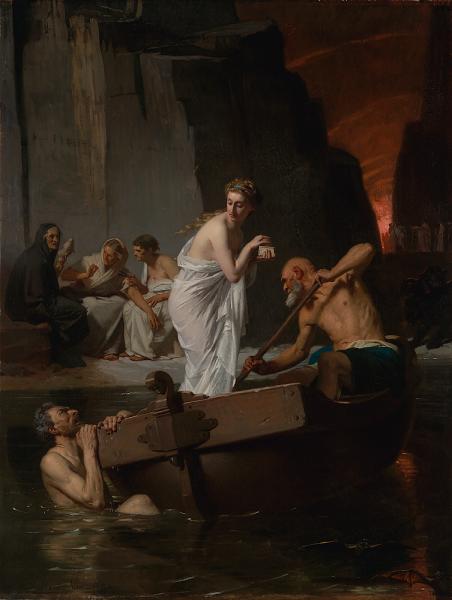
This proclamation was the cause that put all doubt from Psyches, who was scantly come in the sight of the house of Venus, but one of her servants called Custome came out, who espying Psyches, cried with a loud voyce, saying: O wicked harlot as thou art, now at length thou shalt know that thou hast a mistresse above thee. What, dost thou make thy selfe ignorant, as though thou didst not understand what travell wee have taken in searching for thee? I am glad that thou art come into my hands, thou art now in the golfe of hell, and shalt abide the paine and punishment of thy great contumacy, and therewithall she tooke her by the haire, and brought her in, before the presence of the goddesse Venus. When Venus spied her, shee began to laugh, and as angry persons accustome to doe, she shaked her head, and scratched her right eare saying, O goddesse, goddesse, you are now come at length to visit your husband that is in danger of death, by your meanes : bee you assured, I will handle you like a daughter : where be my maidens, Sorrow and Sadnesse? To whom (when they came) she delivered Psyches to be cruelly tormented; then they fulfilled the commandement of their Mistresse, and after they had piteously scourged her with rods and whips, they presented her againe before Venus; then she began to laugh againe, saying : Behold she thinketh (that by reason of her great belly, which she hath gotten by playing the whore) to move me to pitty, and to make me a grandmother to her childe. Am not I happy, that in the flourishing time of al mine age, shall be called a grandmother, and the sonne of a vile harlot shall bee accounted the nephew of Venus : howbeit I am a foole to tearm him by the name of my son, since as the marriage was made betweene unequall persons, in the field without witnesses, and not by the consent of parents, wherefore the marriage is illegitimate, and the childe (that shall be borne) a bastard; if we fortune to suffer thee to live so long till thou be delivered. When Venus had spoken these words she leaped upon the face of poore Psyches, and (tearing her apparell) tooke her by the haire, and dashed her head upon the ground. Then she tooke a great quantity of wheat, of barly, poppy seede, peason, lintles, and beanes, and mingled them altogether on a heape saying : Thou evil favoured girle, thou seemest unable to get the grace of thy lover, by no other meanes, but only by diligent and painefull service, wherefore I will prove what thou canst doe : see that thou separate all these graines one from another, disposing them orderly in their quantity, and let it be done before night. When she had appointed this taske unto Psyches, she departed to a great banket that was prepared that day. But Psyches went not about to dissever the graine, (as being a thing impossible to be brought to passe by reason it lay so confusedly scattered) but being astonyed at the cruell commandement of Venus, sate still and said nothing. Then the little pismire the emote, taking pitty of her great difficulty and labour, cursing the cruellnesse of the daughter of Jupiter, and of so evill a mother, ran about, hither and thither, and called to all her friends, Yee quick sons of the ground, the mother of all things, take mercy on this poore maid, espouse to Cupid, who is in great danger of her person, I pray you helpe her with all diligence. Incontinently one came after another, dissevering and dividing the graine, and after that they had put each kinde of corne in order, they ranne away againe in all haste. When night came, Venus returned home from the banket wel tippled with wine, smelling of balme, and crowned with garlands of roses, who when shee had espied what Psyches had done, gan say, This is not the labour of thy hands, but rather of his that is amorous of thee : then she gave her a morsel of brown bread, and went to sleep. In the mean season, Cupid was closed fast in the surest chamber of the house, partly because he should not hurt himself with wanton dalliance, and partly because he should not speake with his love : so these two lovers were divided one from another. When night was passed Venus called Psyches, and said, Seest thou yonder Forest that extendeth out in length with the river? there be great sheepe shining like gold, and kept by no manner of person. I command thee that thou go thither and bring me home some of the wooll of their fleeces. Psyches arose willingly not to do her commandement, but to throw her selfe headlong into water to end her sorrows. Then a green reed inspired by divine inspiration, with a gratious tune and melody gan say, O Psyches I pray thee not to trouble or pollute my water by the death of thee, and yet beware that thou goe not towards the terrible sheepe of this coast, untill such time as the heat of the sunne be past, for when the sunne is in his force, then seeme they most dreadfull and furious, with their sharpe hornes, their stony foreheads and their gaping throats, wherewith they arme themselves to the destruction of mankinde. But untill they have refreshed themselves in the river, thou must hide thy selfe here by me, under this great plaine tree, and as soone as their great fury is past, thou maist goe among the thickets and bushes under the wood side and gather the lockes their golden Fleeces, which thou shalt finde hanging upon the briers. Then spake the gentle and benigne reed, shewing a mean to Psyches to save her life, which she bore well in memory, and with all diligence went and gathered up such lockes as shee found, and put them in her apron, and carried them home to Venus. Howbeit the danger of this second labour did not please her, nor give her sufficient witnesse of the good service of Psyches, but with a sower resemblance of laughter, did say : Of a certaine I know that this is not thy fact, but I will prove if that thou bee of so stout, so good a courage, and singular prudency as thou seemest to bee. Then Venus spake unto Psyches againe saying : Seest thou the toppe of yonder great Hill, from whence there runneth downe waters of blacke and deadly colour, which nourisheth the floods of Stix, Cocytus? I charge thee to goe thither, and bring me a vessell of that water : wherewithall she gave her a bottle of Christall, menacing and threatening her rigorously. Then poor Psyches went in all haste to the top of the mountaine, rather to end her life, then to fetch any water, and when she was come up to the ridge of the hill, she perceived that it was impossible to bring it to passe : for she saw a great rocke gushing out most horrible fountaines of waters, which ran downe and fell by many stops and passages into the valley beneath : on each side shee did see great Dragons, which were stretching out their long and bloody Neckes, that did never sleepe, but appointed to keepe the river there : the waters seemed to themselves likewise saying, Away; away, what wilt thou doe? flie, flie, or else thou wilt be slaine. Then Psyches (seeing the impossibility of this affaire) stood still as though she were transformed into a stone and although she was present in body, yet was she absent in spirit and sense, by reason of the great perill which she saw, insomuch that she could not comfort her self with weeping, such was the present danger that she was in. But the royall bird of great Jupiter, the Eagle remembring his old service which he had done, when as by the pricke of Cupid he brought up the boy Ganimedes, to the heavens, to be made butler of Jupiter, and minding to shew the like service in the person of the wife of Cupid, came from the high-house of the Skies, and said unto Psyches, O simple woman without all experience, doest thou thinke to get or dip up any drop of this dreadfull water? No, no, assure thy selfe thou art never able to come nigh it, for the Gods themselves do greatly feare at the sight thereof. What, have you not heard, that it is a custome among men to sweare by the puissance of the Gods, and the Gods do sweare by the majesty of the river Stix? but give me thy bottle, and sodainly he tooke it, and filled it with the water of the river, and taking his flight through those cruell and horrible dragons, brought it unto Psyches : who being very joyfull thereof, presented it to Venus, who would not yet be appeased, but menacing more and more said, What, thou seemest unto me a very witch and enchauntresse, that bringest these things to passe, howbeit thou shalt do nothing more. Take this box and to Hell to Proserpina, and desire her to send me a little of her beauty, as much as will serve me the space of one day, and say that such as I had is consumed away since my sonne fell sicke, but returne againe quickly, for I must dresse my selfe therewithall, and goe to the Theatre of the Gods : then poore Psyches perceived the end of all fortune, thinking verely that she should never returne, and not without cause, when as she was compelled to go to the gulfe and furies of hell. Wherefore without any further delay, she went up to an high tower to throw her selfe downe headlong (thinking that it was the next and readiest way to hell) but the tower (as inspired) spake unto her saying, O poore miser, why goest thou about to slay thy selfe? Why dost thou rashly yeeld unto thy last perill and danger? know thou that if thy spirit be once separated from thy body, thou shalt surely go to hell, but never to returne againe, wherefore harken to me; Lacedemon a Citie in Greece is not farre hence: go thou thither and enquire for the hill Tenarus, whereas thou shalt find a hold leading to hell, even to the Pallace of Pluto, but take heede thou go not with emptie hands to that place of darknesse: but Carrie two sops sodden in the flour of barley and Honney in thy hands, and two halfepence in thy mouth. And when thou hast passed a good part of that way, thou shalt see a lame Asse carrying of wood, and a lame fellow driving him, who will desire thee to give him up the sticks that fall downe, but passe thou on and do nothing; by and by thou shalt come unto a river of hell, whereas Charon is ferriman, who will first have his fare paied him, before he will carry the soules over the river in his boat, whereby you may see that avarice raigneth amongst the dead, neither Charon nor Pluto will do any thing for nought: for if it be a poore man that would passe over and lacketh money, he shal be compelled to die in his journey before they will shew him any reliefe, wherefore deliver to carraine Charon one of the halfpence (which thou bearest for thy passage) and let him receive it out of thy mouth. And it shall come to passe as thou sittest in the boat thou shalt see an old man swimming on the top of the river, holding up his deadly hands, and desiring thee to receive him into the barke, but have no regard to his piteous cry; when thou art passed over the floud, thou shalt espie old women spinning, who will desire thee to helpe them, hut beware thou do not consent unto them in any case, for these and like baits and traps will Venus set to make thee let fall one of thy sops, and thinke not that the keeping of thy sops is a light matter, for if thou leese one of them thou shalt be assured never to returne againe to this world. Then shalt thou see a great and marvailous dogge, with three heads, barking continually at the soules of such as enter in, but he can do them no other harme, he lieth day and night before the gate of Proserpina, and keepeth the house of Pluto with great diligence, to whom if thou cast one of thy sops, thou maist have accesse to Proserpina without all danger : shee will make thee good cheere, and entertaine thee with delicate meate and drinke, but sit thou upon the ground, and desire browne bread, and then declare thy message unto her, and when thou hast received such beauty as she giveth, in thy returne appease the rage of the dogge with thy other sop, and give thy other halfe penny to covetous Charon, and come the same way againe into the world as thou wentest : but above all things have a regard that thou looke not in the boxe, neither be not too curious about the treasure of the divine beauty. In this manner tire tower spake unto Psyches, and advertised her what she should do : and immediately she tooke two halfe pence, two sops, and all things necessary, and went to the mountaine Tenarus to go towards hell. After that Psyches had passed by the lame Asse, paid her halfe pennie for passage, neglected the old man in the river, denyed to helpe the woman spinning, and filled the ravenous month of the dogge with a sop, shee came to the chamber of Proserpina. There Psyches would not sit in any royall seate, nor eate any delicate meates, but kneeled at the feete of Proserpina, onely contented with course bread, declared her message, and after she had received a mysticall secret in a boxe, she departed, and stopped the mouth of the dogge with the other sop, and paied the boatman the other halfe penny. When Psyches was returned from hell, to the light of the world, shee was ravished with great desire, saying, Am not I a foole, that knowing that I carrie here the divine beauty, will not take a little thereof to garnish my face, to please my love withall? And by and by shee opened the boxe where she could perceive no beauty nor any thing else, save onely an infernall and deadly sleepe, which immediatly invaded all her members as soone as the boxe was uncovered, in such sort that she fell downe upon the ground, and lay there as a sleeping corps.
But Cupid being now healed of his wound and Maladie, not able to endure the absence of Psyches, got him secretly out at a window of the chamber where hee was enclosed, and (receiving his wings,) tooke his flight towards his loving wife, whom when he had found, hee wiped away the sleepe from her face, and put it againe into the boxe, and awaked her with the tip of one of his arrows, saying : O wretched Caitife, behold thou wert well-nigh perished againe, with the overmuch curiositie : well, goe thou, and do thy message to my Mother, and in the meane season, I will provide for all things accordingly : wherewithall he tooke his flight into the aire, and Psyches brought her present to Venus.
Cupid being more and more in love with Psyches, and fearing the displeasure of his Mother, did pearce into the heavens, and arrived before Jupiter to declare his cause : then Jupiter after that hee had eftsoone embraced him, gan say in this manner : O my well beloved sonne, although thou haste not given due reverence and honour unto me as thou oughtest to doe, but haste rather spoiled and wounded this my brest (whereby the laws and order of the Elements and Planets be disposed) with continuall assaults, of Terren luxury and against all laws, and the discipline Julia, and the utility of the publike weale, in transforming my divine beauty into serpents, fire, savage beasts, birds, and into Bulles : howbeit remembring my modesty, and that I have nourished thee with mine owne proper hands, I will doe and accomplish all thy desire, so that thou canst beware of spitefull and envious persons. And if there be any excellent Maiden of comely beauty in the world, remember yet the benefit which I shall shew unto thee by recompence of her love towards me againe. When lie had spoken these words he commanded Mercury to call all the gods to counsell, and if any of the celestiall powers did faile of appearance he would be condemned in ten thousand pounds : which sentence was such a terrour to all the goddesses, that the high Theatre was replenished, and Jupiter began to speake in this sort : O yee gods, registred in the bookes of the Muses, you all know this young man Cupid whom I have nourished with mine owne hands, whose raging flames of his first youth, I thought best to bridle and restraine. It sufficeth that hee is defamed in every place for his adulterous living, wherefore all occasion ought to bee taken away by meane of marriage : he hath chosen a Maiden that fancieth him well, and hath bereaved her of her virginity, let him have her still, and possesse her according to his owne pleasure : then he returned to Venus, and said, And you my daughter, take you no care, neither feare the dishonour of your progeny and estate, neither have regard in that it is a mortall marriage, for it seemeth unto me just, lawfull, and legitimate by the law civill. Incontinently after Jupiter commanded Mercury to bring up Psyches, the spouse of Cupid, into the Pallace of heaven. And then he tooke a pot of immortality, and said, Hold Psyches, and drinke, to the end thou maist be immortall, and that Cupid may be thine everlasting husband. By and by the great banket and marriage feast was sumptuously prepared, Cupid sate downe with his deare spouse between his armes : Juno likewise with Jupiter, and all the other gods in order, Ganimedes filled the pot of Jupiter, and Bacchus served the rest. Their drinke was Nectar the wine of the gods, Vulcanus prepared supper, the howers decked up the house with roses and other sweet smells, the graces threw about blame, the Muses sang with sweet harmony, Apollo tuned pleasantly to the Harpe, Venus danced finely : Satirus and Paniscus plaid on their pipes; and thus Psyches was married to Cupid, and after she was delivered of a child whom we call Pleasure. This the trifling old woman declared unto the captive maiden : but I poore Asse, not standing farre of, was not a little sorry in that I lacked pen and inke to write so worthy a tale.
Resource
http://ancienthistory.about.com